


Between mountains, plains, and coast, Portugal is like an outdoor lab for those who enjoy looking upwards.
You don’t have to be an astronomer, nor travel with a tripod and telescope. All you need is the will to exchange your screen for the night sky for a few nights. At these hotels, sleeping beneath the stars isn’t a figure of speech – it’s all about letting the sky take centre stage on your itinerary.
The Alentejo and the luxury of darkness
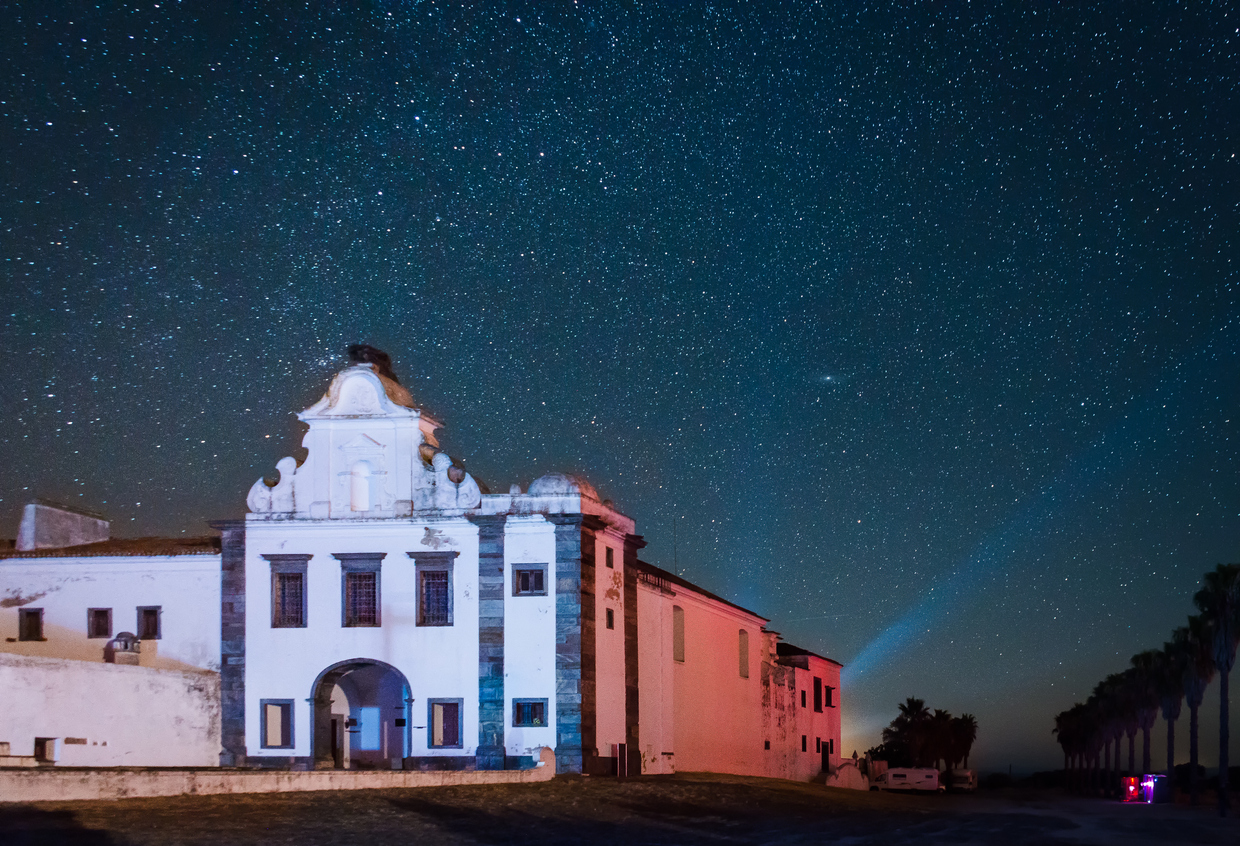
In the hotels in Alentejo, the greatest asset is the combination of broad horizons with little light pollution. The night becomes dense, inviting contemplation. Many evenings, simply moving a few metres away from the hotel’s main building is enough to have a practically undisturbed sky. A typical day can start with a trip to Évora, Vila Viçosa, Elvas or Beja, depending which hotel you choose as your base, and continue with visits to castles, cromlechs or small villages, where time seems to pass more slowly.
When the hotel’s lights dim, the Alentejo sky comes to the fore. The trick here is to have dinner early, wear a warmer coat, take a discreet torch and, if possible, a sky map app for the first minutes. Then, it’s worth turning the screen off and letting your eyes become accustomed to the darkness. For something more structured, there are two major references in the Alentejo: the sessions at Dark Sky Alqueva, in Cumeada, or Alqueva Lake Observatory (OLA), near Monsaraz, both with guided night observation programmes with telescopes and astronomers.
Mountains, valleys and a ceiling of stars in Gerês
The sky always engages into conversation with the topography, when observed from a hotel in Peneda-Gerês National Park. The stars aren’t always on high: they appear and disappear among the outlines of the mountains.
Anyone lounging on a balcony overlooking the valley can’t help but notice how the cloud movement, the wind direction and even humidity become visible. To make the experiment more “scientific”, observe the same constellation at three different times: after dinner, half an hour later and before bedtime. Seeing how it moves, in relation to the mountains, makes what seems abstract on the map much more concrete.
Another interesting detail is the way fauna responds to the darkness. It’s not unusual to hear owls or see the shadows of bats in your field of vision, which makes a night on a veranda quite the thing. For those wanting to go to the next level and experience an evening entirely dedicated to astronomy, we suggest a trip to Porta do Mezio Dark Sky Reserve, in Arcos de Valdevez, where the ARDAL provides guided tours with telescopies and other activities. Programmes like “Star visits at the Peneda‑Gerês National Park” and mini-nocturnal treks organised by local authorities (like Terras de Bouro or Terras do Homem) occasionally provide guided stargazing sessions.
In Serra da Estrela, the sky can be seen from the heights
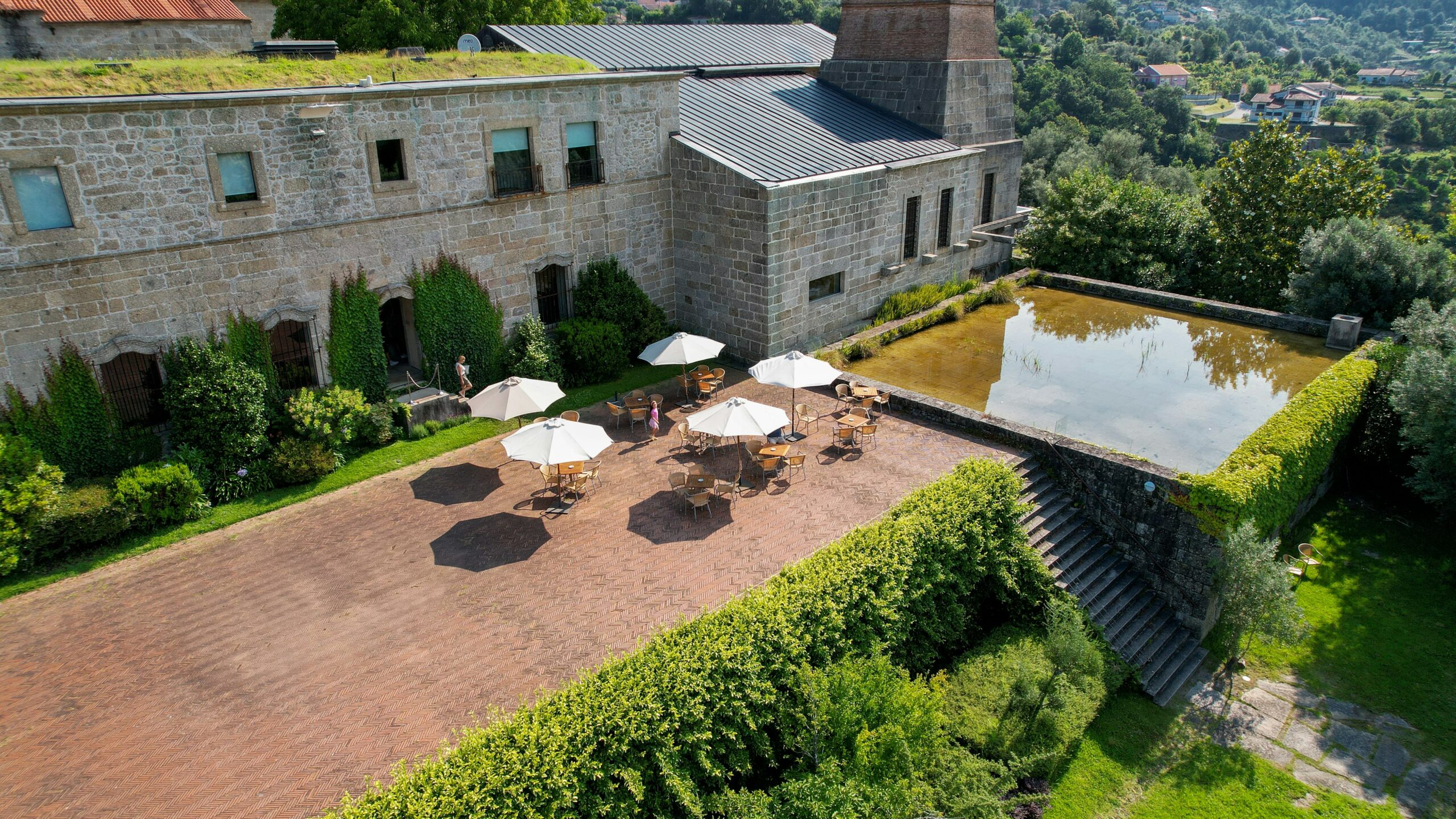
In the historic hotel in Serra da Estrela, the experience of sleeping beneath the stars comes with a certain context: thick walls, rooms with a fireplace, subtle tones, such as blue, white and grey, used in ambiences that combine austerity and minimalism. Then, a door opens, leading to the outside and the scenario completely changes: the sky seems closer, partially due to the altitude. Actually, here you can really tell the difference in brightness between a star and a planet. In a clearer sky, it’s easier to see which points are twinkling and which ones keep a more steady light (the latter usually being the planets). For many, it is the first time that they can identify, with the naked eye, something that isn’t just anything that shines. For more serious astronomical observation – above 1,500 metres, with telescopes and scientific framework – Portugal4Fun is a benchmark.
Between the sky and sea at Serra da Arrábida
Not far from cities like Lisbon and Setúbal, a less obvious destination delivers what you expect from an impressive sky. Seen from a hotel with view of the Serra da Arrábida, the firmament shares the setting with the sea and the abrupt outline of the slopes. The nearness of the aforementioned cities always leaves a halo of light on the horizon, creating a contrast between lit areas and pockets of darkness above the Atlantic and the national park – on clear night skies, the difference becomes obvious. It’s not a remote scenario; however, it’s exactly this accessibility that makes it interesting: showing that you don’t have to span the country to have the sky as company.
When the goal is more ambitious, it’s worth including the “Há Estrelas na Arrábida” initiatives organised by the Setúbal municipality, in conjunction with science communicators. On these evenings, telescopes and monitors are placed at the high points of the park to observe planets, star clusters and other deep-sky objects, complementing the experience for those who want to turn the night landscape into an activity.


