


These eight beaches aren’t exactly a secret (in 2026, almost nothing is), but they still require a desire to scout around, walk that extra mile and accept fewer amenities in exchange for more space and peace.
There are those who associate beaches with long lines of parasols, bars full of people and beach towels placed side by side, millimetres apart. That said, there are others who seek the opposite: discreet sands, less obvious accesses, space between sunbathers. This itinerary includes some of these havens, stretching from north to south, including the islands, and the cherry on the cake: hotels near the beach.
Fajã dos Padres, Madeira
Fajã dos Padres is like a well-known secret: everyone has heard about it, but it still seems like a world apart. You get there by cable car or by boat, which helps filter the crowds and reinforces the sense of a “bubble” when you arrive below. This pebble beach has a small pier, which helps people get into the water, and towels are spread out a few metres from banana trees. There’s no sandy area suitable for a long stroll, but this beach is surrounded by farmland, sea, cliffs, scarps and silence.
Porto das Salemas, Porto Santo
Porto Santo isn’t a secret, but the way you discover the island might be. Instead of always choosing the same part of the main beach, it’s worth walking, preferably northwards. There you’ll find Porto das Salemas, a volcanic cove with natural pools, with crystalline warm waters. The challenge is getting there, as the access path crosses private property and doesn’t always offer passage. Some days you hit the jackpot.
Praia dos Coelhos, Arrábida
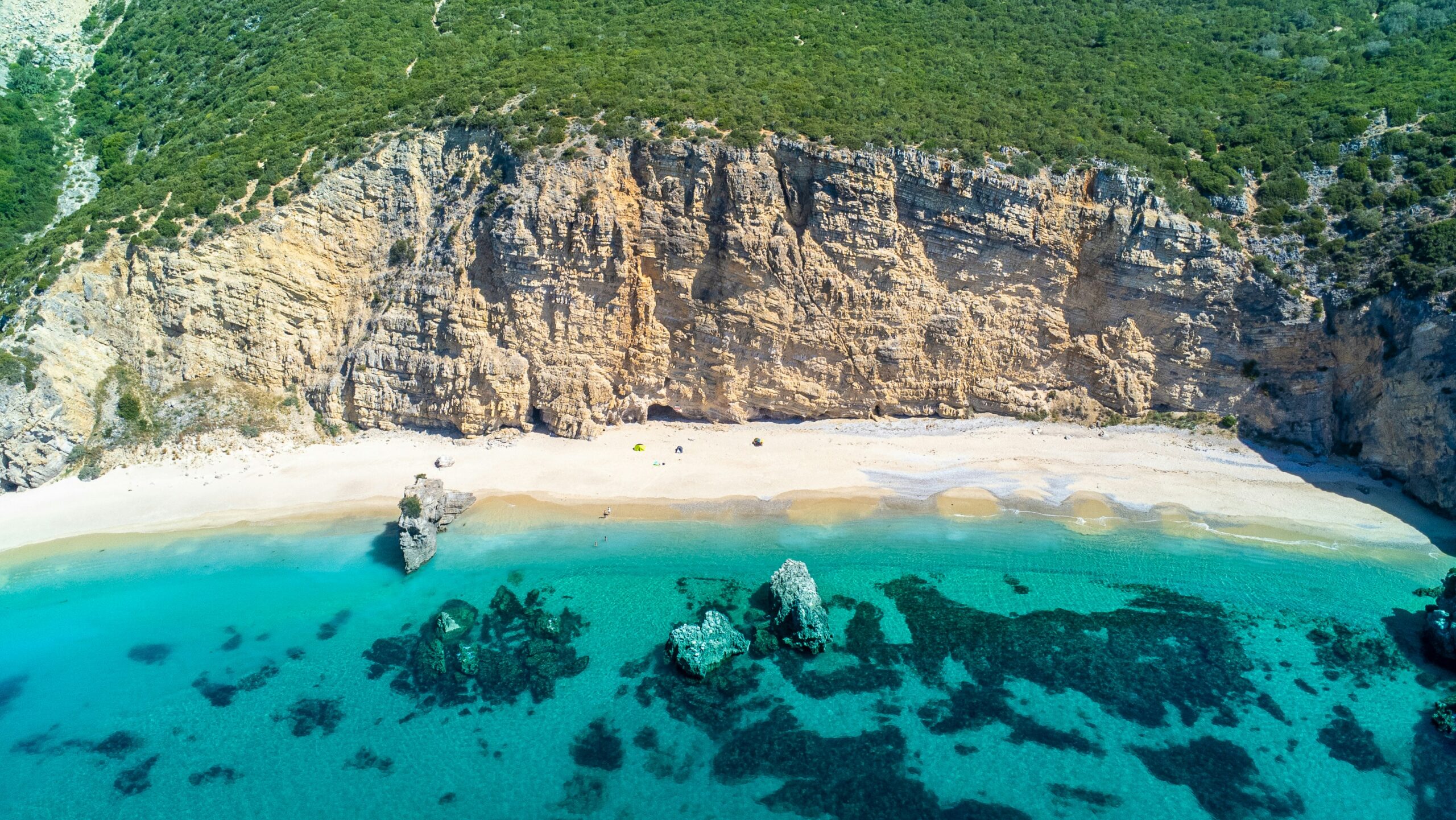
Praia dos Coelhos, in Serra da Arrábida, is one of those beaches that still feels like a new discovery, despite appearing in top-notch travel lists and guides. Those interested in getting there have to take a trail that descends the slope, which keeps away people who prefer to park as near as possible. At the bottom, the reward is worth seeing: transparent water, quiet sands and the green of the mountains framing the bay.
Praia do Burrinho, Porto Covo
North of Porto Covo, slightly away from the classic circuit of more photogenic beaches, Praia do Burrinho is like a pause between cliff outlines. It doesn’t have the large sands of the region, instead it’s more like a rock amphitheatre with a small sand sheet, which is precisely what makes it special. Access is achieved via a dirt road, from the municipal road, or as part of the larger trail that link the different beaches. Some care is required when descending to the beach. If it’s a weekday, and not in August, you’ll probably find the cove completely deserted.
Praia do Abano, Cascais
In Cascais, the word “secret” is relative, but there are small spots where you can escape the most popular places. Between Guincho and Cabo Raso, the coast hides small rocky slabs, small recesses and natural platforms, where it’s possible to spread a towel far away from the noise of beach bars. They’re not the classic beaches of the “endless sands”, they are more like verandas overlooking the Atlantic. A good example is Praia do Abano, located north of Praia do Guincho, known for its wild appearance and frequently a place for naturism. Access is achieved via a dirt road.
Praia do Pinheirinho, Alcácer do Sal
Around a half an hour from Alcácer do Sal, there are many paradise beaches, which extend for over 40 kilometres of sands, which make it the largest stretch of beach in Europe and the third largest in the world. In between, there are various less well-known examples, such as Pinheirinho, which is somewhat wild and reached via a dirt road and trails in the dunes. The sands are large enough to avoid the need for neighbourly chats.
Tróia islets, Tróia
All of Tróia is like paradise, but even more so when seen from afar. The Tróia islets are a sequence of pale sandbanks and stretches of near-deserted beaches, accessible only by boat from Setúbal or along the peninsula itself. They emerge at low tide before disappearing at high tide, as if they were a dream.
Praia do Barranco, Algarve
Even in such a popular region, there are still one or two beaches that escape the tourist crowds. In the western area of the Algarve, between Lagos and Aljezur, it’s worth exploring more secluded coves, which are accessed via dirt tracks or steps carved into the cliff face, well away from the large car parks. Praia do Barranco is a little wild and accessed via a dirt track, with no facilities, which makes it a perfect example of an off-the-beaten-track beach.


