

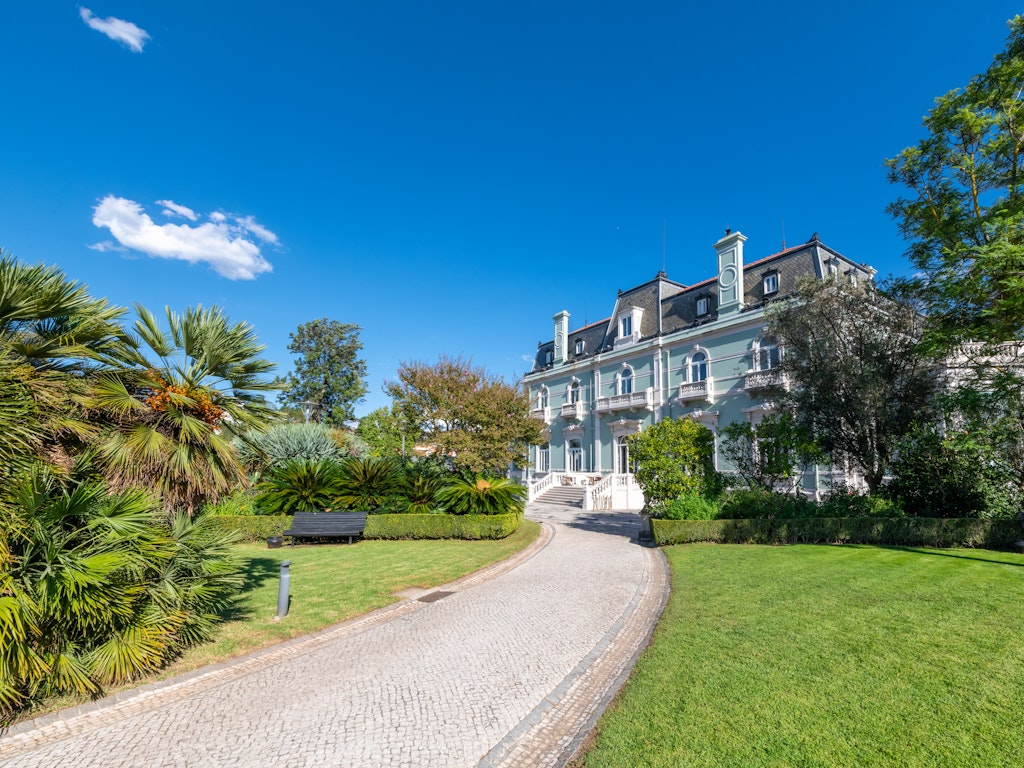

25 years ago, what was the Valle-Flôr Palace opened its doors to a new life, after having been transformed into the Pestana Palace Lisboa. Classified as a National Monument and a member of The Leading Hotels of the World, it now celebrates a quarter of a century as one of the finest examples of Lisbon’s hospitality.
The history of the palace stretches back to the 19th century and an unlikely journey of a young man from Trás-os-Montes, who set off for São Tomé, aged 16, to become a major figure in the cocoa industry. It was his success abroad that allowed José Luís Constantino Dias, the future Marquis of Valle-Flôr, to dream about a special residence in Lisbon as tall as his ambition, set on a plot of land in Alto de Santo Amaro given by King Carlos. The result was a cosmopolitan spot visited by distinguished figures, who soon made it the centre of Lisbon’s social life at the time.
The construction was done in various stages, between the end of the 19th century and the beginning of the 20th, with initial design by the Italian architect Nicola Bigaglia and concluded by the Portuguese architect José Ferreira da Costa. As for the interiors, the family decided that Parisian design was the best choice. The palace has Italian, French and Asian influences, thus creating a blend that turned it into a living museum of decorative styles.
After the death of the Marquis, in 1932, the building endured a period of decay and was left abandoned. It was even considered as a potential building for state functions, such as the HQ for the Council of Ministers, but no purpose was found for it. In 1991, the Pestana group acquired the building and began the long process of conservation, restoration and construction that took around a decade. In 2001, it finally opened as a 5-star hotel in Lisbon, with spa and pool, returning the façades, interiors and Palácio Valle-Flôr gardens to their original splendour, for the benefit of the city.
Since then, the Pestana Palace Lisboa has consolidated its reputation as one of the most beautiful hotels in Portugal’s capital, distinguished by international luxury collections like The Leading Hotels of the World and classified as a National Monument. It’s not only a hotel, nor just a palace, but rather a place where modern life seamlessly inhabits a historic setting.
Right at the entrance, features rarely seen in hotels, like stained-glass high windows and a central dome, signal the building’s unique character. The marble staircases lead to the first floor, where themed rooms are arranged, such as the Rococo-inspired Blue Room, the Italian-style Green Room, the Japanese Room with its strong Asian influence, and the Renaissance Room, which is the family’s former dining room.
Built at a later stage, and consecrated by the Vatican, the chapel is another iconic place. Dedicated to the Immaculate Conception, it retains the original furniture, the stained glass that floods the space with light and a historical organ that was hidden for almost 20 years, until it was rediscovered behind the altar.
Outside, the gardens extend the palatial scenario. The landscape complex, which features over 1,000 lush and exotic species, is also designated a National Monument and inspired by French gardens in Versailles style, on a much smaller scale. Among the sculptures representing the seasons, there’s the outdoor pool, created from the palace’s former lake, and the Casa do Lago, a Chinese-inspired pavilion that currently serves meals.
The hotel adaptation project brought new bedroom wings, with 190 rooms featuring elegant and classic décor entrusted to the architect Jaime Morais. In the historical areas, the four royal suites King Luís, King Manuel, Queen Amélia and King Carlos maintain the authentic atmosphere of the family’ former chambers.
As for wellbeing, it’s worth mentioning the health club with indoor pool, jacuzzi, gym and the Magic Spa by Pestana, the group’s spa brand. An outdoor pool, set within the gardens, and outdoor relaxation areas, turn summer days into a resort-style experience in the heart of the city. It’s this combination of spa, pool, gardens and palace that makes the Pestana Palace Lisboa a unique choice amongst Lisbon’s luxury options.
In 25 years, the Pestana Palace Lisboa has gone from being a restored palace to an international benchmark and from being a brand-new hotel to a city classic. Essentially, it’s still a hotel with the soul of a palace, where people have breakfast in an old ballroom and where you can swim in a pool built on the site of a former lake. The celebrations for the 25th anniversary of the Pestana Palace Lisboa acknowledge this journey, from an entrepreneur’s dream in São Tomé to its reinvention, a century later, as one of the most unique hotels in the Portuguese capital.


