


Amidst mountains, medieval cities, bohemian beaches and Roman ruins by the sea, Barcelona is the starting point to explore Catalonia. Just catch a morning train and return at the end of the day, without the need to unpack.
Barcelona has so much to see and do that you could easily spend several days there without repeating your itinerary. There’s Gaudí, historic neighbourhoods, museums, markets, urban beaches and cuisine to discover. But the city also serves as a starting point for anyone who wishes to gain a better understanding of Catalonia as a whole. From a hotel in Barcelona, it’s easy to swap the metropolis for the mountain, sea or heritage, and be back in time for dinner in the city.
Montserrat
Montserrat is perhaps the best known detour. The mountain is striking from a distance, with its rugged, mighty formations. Set against this backdrop stands the Benedictine monastery of Santa Maria de Montserrat, a place that symbolises Catalan identity.
The trip is part of the programme. From Plaça d’Espanya, catch the train on line R5 heading Manresa; then, choose between the Aeri de Montserrat cable car or the Cremallera cogwheel train that climbs the mountain. At the top, it’s worth starting with the monastery and the basilica, where we find Moreneta, the image of the Virgin of Montserrat. Then, the funiculars of Sant Joan and Santa Cova offer access to the starting points for walking trails and viewpoints, offering views over the mountain and the Catalan plain.
Sitges
This small coastal town is still picturesque, with a white-washed historic centre, narrow streets and right there by the beach. The R2 Sud train departs from stations like Barcelona Sants and Passeig de Gràcia and reaches Sitges in around 40 minutes. From the station, the sea is a few steps away. It’s worth walking to the iconic church of Sant Bartomeu i Santa Tecla, one of the town’s most interesting sights – from where you can see the beach, the seafront promenade and the white-washed houses.
For a long time, Sitges was a haven for artists, writers and the wealthy families of Barcelona. The Modernist houses, the museums and the careful scale of the city are still witnesses to that past. The Cau Ferrat Museum, the old house of artist Santiago Rusiñol, is a good starting point to understand that connection to the arts; the Palau Maricel completes the tour.
Sitges invites visitors to sit (and linger) at the table, amongst fresh fish, rice, tapas or just an appetiser by the sea. The San Sebastià beach is a more quiet choice than the more central areas. With a little help from the weather forecast, this is one of those getaways that can end up with a dip in the sea.
Girona
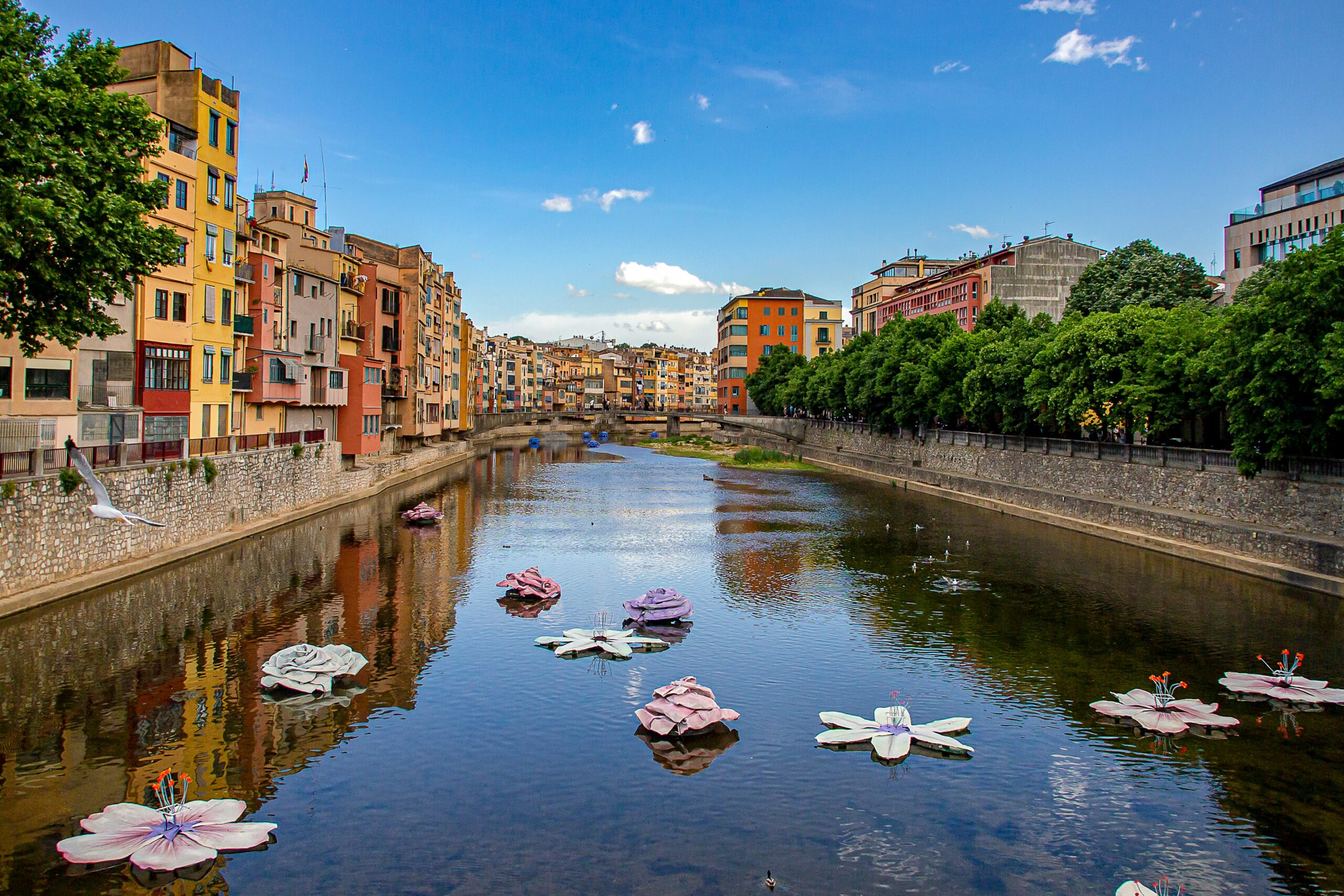
About half an hour by high-speed train from Barcelona, Girona is compact in size but boasts an impressive wealth of history, with city walls, stairways, medieval alleyways, bridges over the River Onyar and colourful façades that became one of Catalonia’s most iconic sights. It is a city that requires an eye for detail and some energy to tackle the uphill and downhill.
AVE and Avant trains depart from Barcelona Sants, arriving in Girona in less than 40 minutes; additionally, there are regional services, which take longer but are usually cheaper. The station is a short walk from the city centre, which makes getting around quite easy.
In Call, the Jewish quarter, the narrow, sloping streets lead to courtyards, hidden corners and niche shops. Girona Cathedral, with its monumental staircase and vast Gothic nave, is a must.
One of the best ways to end your visit is to climb the ramparts, which offer views over the city’s rooftops, the cathedral’s towers and the green landscape that begins right beyond the city centre. Next, go to the more contemporary part of town, look for a patisserie, find a bookshop or just enjoy an outdoor café.
Tarragona
Ancient Tarraco, now known as Tarragona, was considered one of the key cities of the Roman Empire on the Iberian Peninsula, home to monuments that continue to define the city’s skyline. It’s particularly interesting for those who enjoy archaeology without giving up on the seaside and good food.
You can go by train from Barcelona Sants. Regional services take between 60 and 90 minutes, while some faster services can reduce the journey time considerably. It’s worth checking your arrival station, as Camp de Tarragona is outside the city centre and Tarragona station is closer to the main sights. Once in the city, many of the must-see attractions can be explored on foot.
The amphitheatre is a landmark in the city, but let’s not forget the provincial forum, the circus, part of the city walls and the Praetorium. It’s also worth strolling along the Rambla Nova to the Balcó del Mediterrani, the viewpoint overlooking the amphitheatre, Miracle Beach and the horizon. It’s a good spot to take a break and appreciate how this Roman legacy and everyday life coexist just a few metres from the Mediterranean. With its outdoor cafés, local shops and streets leading down towards the historic centre, the city invites you to extend your stroll until late afternoon.
Blanes
Considered a gateway to the Costa Brava, Blanes is a destination for walking slowly, for dining on fresh fish and swapping the buzz of Barcelona for a Mediterranean landscape.
The trip can be made on Rodalies’ R1 line, departing from stations like Barcelona Sants, Plaça de Catalunya, Arc de Triomf or Passeig de Gràcia. It takes less than an hour and a half to get to Blanes by train, following much of the Maresme coastline. Don’t forget that the train station is some distance from the town centre and the beaches, so you’ll need to continue your journey by bus, taxi or on foot, depending on your choice.
The main attraction here is the Marimurtra Jardí Botànic (Botanical Garden), which is set on a cliff, overlooking the Mediterranean. The garden brings together plant species from different climate zones and offers some of the most photogenic views on the Costa Brava as you walk through it: stairways, paths winding through the vegetation and balconies suspended over the sea.
After the visit, go to the coast and head to Sa Forcanera, a small cove surrounded by cliffs and pine trees, or try Blanes beach, which is more central and ideal for a swim and late lunch. To finish off the day with a view, the Sa Palomera headland – the rock that symbolically marks the start of the Costa Brava – offers a sweeping view of the coastline and the town.


